If you’ve ever watched your autistic child go from zero to completely overwhelmed in what feels like seconds — melting down, shutting down, bolting, or suddenly lashing out — and found yourself thinking what just happened? — I want to talk about something that completely changed the way I see those moments.
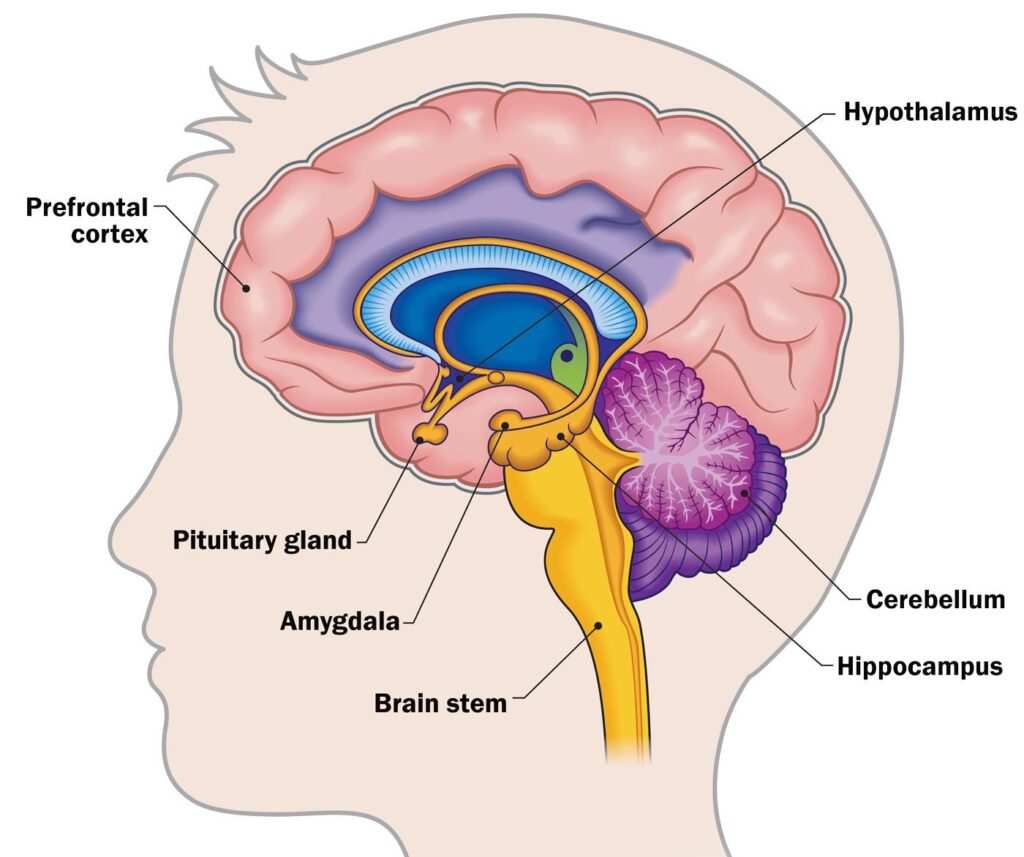
It’s called the amygdala. And once you understand what it does, so much of what our kids experience starts to make a lot more sense.
I first came across it mentioned in Strong Female Character by Fern Brady (brilliant book, by the way — I’d highly recommend it). The amygdala is basically the brain’s alarm system. And in many autistic people, that alarm system is wired differently. It’s louder. It’s faster. And it is really hard to switch off.
This isn’t about bad behaviour. It isn’t about poor coping. It’s neurobiology — and understanding that changes everything.
So what actually is the amygdala?
It’s a tiny, almond-shaped structure deep in the brain, and its entire job is survival. It’s constantly scanning the environment and asking one question: Am I safe?
The moment it detects a threat — real or not — it fires off the fight, flight, freeze, or fawn response. Heart racing. Breathing faster. Muscles tensing. And here’s the part that’s really important: logical thinking goes offline. Because when your brain thinks you’re in danger, survival comes first. Thinking can wait.
This all happens in a split second, before any conscious decision has been made.g fast. It bypasses rational thought because survival comes first.
Why is it different in autistic brains?
Research suggests autistic people often show differences in how their amygdala is structured, how it connects to other parts of the brain, and how reactive it is. Some studies have found it’s larger in early childhood, or that it responds more intensely to sensory and emotional input.
I think of it like a smoke alarm.
In a neurotypical brain, the alarm goes off when there’s an actual fire. In a hyper-reactive brain — like many of our kids’ — the alarm goes off when you make toast. It’s not broken. It’s just incredibly sensitive.
Why does everything feel like a threat?
Autistic people often process sensory information far more intensely than neurotypical people do. The things that others barely notice — background noise, bright lights, a crowded room, an unexpected smell, someone brushing past them — can feel genuinely overwhelming. Painful, even.
Blake is incredibly sensory. His sensitivity to touch and smell is something I’ve had to think about every single day of his life. What feels like nothing to me can feel completely unbearable to him.
When the amygdala interprets these everyday experiences as danger, the body responds accordingly. Even though there’s no actual threat. Even though everyone else in the room seems fine. To the nervous system, it is absolutely real — and it reacts as if it is.
That’s when you see the meltdowns. The shutdowns. The running. The lashing out. And none of it is a choice.
And this is where it can actually become dangerous
When survival mode takes over, the priority is escape or protection — not social awareness, not long-term consequences, not listening to reason. Nothing else matters except getting safe.
So an autistic child might bolt into traffic to get away from a noise. They might lash out when they feel cornered. They might hide somewhere unsafe, or run from the very people who are trying to help them. Because in that moment, everything feels threatening.
From the outside, it looks impulsive. It looks oppositional. It can look like naughtiness or defiance.
But it’s fear. Pure, overwhelming fear — with no way out.
It’s not “bad behaviour” — it’s a survival response
This is the shift in thinking that I genuinely believe every parent, teacher, and support worker needs to make.
Instead of asking “Why are they acting like this?” — we need to be asking “What feels unsafe right now?”
Because the moment you start seeing it through that lens, everything changes. You stop trying to enforce compliance — and you start trying to reduce threat. And that is what actually helps.
Things like predictability and routine. Sensory accommodations. Calm, low-demand communication. A safe space to retreat to. A trusted person to co-regulate with. Safety — genuine felt safety — is what restores the nervous system. And only once the nervous system is calm can any kind of learning or problem-solving even begin.
The same sensitivity that causes the alarm to blare… also brings real gifts
I want to say this, because I think it’s important.
Autistic brains aren’t defective neurotypical brains. They’re differently wired. And a sensitive amygdala — the very thing that makes the world feel so overwhelming — is often connected to the most beautiful parts of who our kids are.
The fierce empathy. The ability to spot injustice from a mile away. The incredible attention to detail. The passion that runs so deep it takes your breath away. Matthew’s love of history, his intensity, the way he talks about things he cares about — that’s not separate from his autism. It’s part of it.
The same system that fires off alarm bells when the supermarket is too loud… is also the system that makes him feel things so deeply. That makes him him.
What I want you to take from this
When your child reacts strongly — when they shut down, lash out, bolt, or completely fall apart — they are not overreacting. Their brain has sounded the alarm. And in that moment, what they need most isn’t discipline. It isn’t logic. It isn’t you trying to talk them round.
They need to feel safe.
That’s it. That’s the whole thing.
And I know how hard it is to hold onto that in the middle of a meltdown in the supermarket with everyone staring. Believe me, I know. But understanding why it’s happening — really understanding it — makes it just that little bit easier to meet them where they are instead of where you wish they could be.