If you’ve ever wondered why some autistic individuals seem to react to situations with overwhelming intensity — shutting down, melting down, fleeing, or appearing suddenly defensive — the answer may lie deep within the brain, in a small almond-shaped structure called the amygdala.
Spoken about in books like Strong Female Character by Fern Brady, the amygdala is often described as the brain’s “alarm system.” But for many autistic people, this alarm system may be wired differently — sometimes louder, faster, or harder to switch off.
This isn’t about weakness, bad behaviour, or poor coping. It’s about neurobiology.
What Is the Amygdala? 🔔
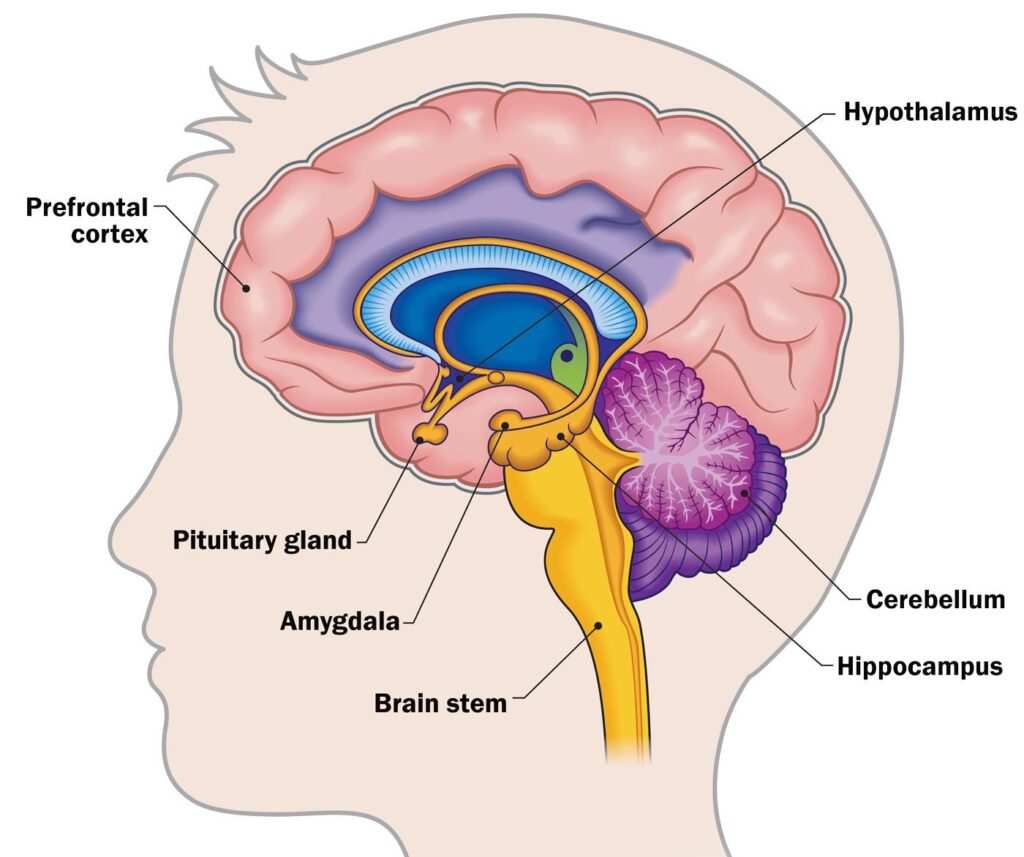
The amygdala is part of the limbic system, the brain’s emotional centre. Its job is survival.
It constantly scans for danger and answers one crucial question:
“Am I safe?”
When the amygdala detects a threat — real or perceived — it triggers the fight, flight, freeze, or fawn response:
- ❤️ Heart rate increases
- 💨 Breathing speeds up
- 💪 Muscles tense
- 🧠 Logical thinking decreases
- 🚨 Stress hormones flood the body
This response is automatic and lightning fast. It bypasses rational thought because survival comes first.
Amygdala Differences in Autistic Brains 🧩
Research suggests that autistic individuals often show differences in amygdala structure, connectivity, and activation. Findings vary, but studies have reported:
- An amygdala that is larger in early childhood
- In some cases, smaller or differently developed later
- Hyper-reactivity to sensory and emotional stimuli
- Differences in how the amygdala communicates with other brain regions
What matters most isn’t simply size — it’s sensitivity and regulation.
Think of it like a smoke alarm:
- A neurotypical brain: alarm goes off when there’s a fire 🔥
- A hyper-reactive amygdala: alarm goes off when you make toast 🍞
- A hypo-responsive system: alarm might not go off even when smoke builds
Why Threat Can Be Detected More Quickly ⚡
Autistic people often process sensory information more intensely. Everyday experiences that others filter out can feel overwhelming or even painful:
- Loud noises
- Bright lights
- Crowds
- Strong smells
- Unexpected touch
- Social unpredictability
If the amygdala interprets these as danger, the body goes into survival mode — even when there is no physical threat.
This can lead to:
- Sudden panic or distress
- Meltdowns or shutdowns
- Running away from situations
- Defensive reactions
- Aggression driven by fear (not intent)
Importantly, during this state, the “thinking brain” (prefrontal cortex) goes offline. The person is not choosing their reaction — their nervous system is.
Why This Can Lead to Dangerous Situations 🚨
When survival mode activates, the priority is escape or protection, not social rules or long-term consequences.
An autistic person might:
- Bolt into traffic to escape noise
- Lash out when cornered or touched
- Hide in unsafe places
- Run from caregivers
- Refuse help because everything feels threatening
From the outside, this can look impulsive or oppositional. In reality, it is fear-driven.
As a mum of autistic children, you may recognise this instantly — the moment when reasoning stops working because panic has taken over. 💔
Not “Bad Behaviour” — A Survival Response ❤️
Understanding the amygdala reframes behaviour completely.
Instead of asking:
❌ “Why are they acting like this?”
We ask:
✅ “What feels unsafe right now?”
Support then shifts toward reducing threat, not enforcing compliance.
Helpful approaches include:
- Predictability and routine
- Sensory accommodations
- Calm, low-demand communication
- Safe spaces to retreat
- Co-regulation from trusted people
Safety restores the nervous system — and only then can learning or problem-solving happen.
A Different Brain, Not a Broken One 🌈
Autistic brains are not defective neurotypical brains. They are differently wired.
A sensitive amygdala may also contribute to strengths often seen in autistic individuals:
- Deep empathy (especially for animals or injustice)
- Heightened awareness of details
- Strong intuition about authenticity
- Passion and intensity
- Protective instincts
The same system that detects danger quickly can also detect beauty, patterns, and emotional truth.
Final Thoughts ✨
Understanding the amygdala helps replace judgment with compassion.
When an autistic person reacts strongly, they are not “overreacting” — their brain has sounded the alarm.
And when the alarm is blaring, what they need most is not discipline or logic…
They need to feel safe.